핵심 요약
- 고령층은 추위에 둔감해 저체온과 혈관 수축에 취약합니다.
- 떨림, 어눌한 말투는 저체온 초기 신호이니 즉시 따뜻하게 해주세요.
- 실내 온도는 18~20도 유지하고, 외출 시 여러 겹 옷을 입으세요.
- 찬바람에 혈압이 급상승하니 혈압약 복용과 체온 변화에 주의하세요.
- 가슴 통증, 호흡곤란 등 이상 증상 시 즉시 119에 신고해야 합니다.
![Create a high-quality image for a blog article.
Description: 50대 후반 남성이 현관에서 외출 전 목도리와 모자를 착용하고 있는 장면, 실내는 따뜻하고 창밖은 겨울 나뭇가지가 보이는 아침 풍경
Style: healthy and active lifestyle photography
Requirements:
- Photorealistic or high-quality illustration
- No text overlays (if text is needed, use large bold sans-serif fonts)
- Professional quality suitable for blog content
- Visually appealing and relevant to the description
- If any Korean text appears, it must be properly composed and OCR-readable
- NO broken, distorted, or illegible characters
Additional requirements:
[STYLE & TIME]
Create realistic documentary / photojournalism-style images suitable for Korean editorial, health, silver, lifestyle, travel, food, household, and informational content.
Use natural daylight or soft realistic indoor light, candid situations, natural skin texture, believable depth of field, and realistic contemporary environments.
Default to present-day Korea unless the article specifies another country, city, region, or historical period.
Do not hardcode a calendar year.
Determine time and season in this order:
1. Follow any date, season, weather, or period explicitly stated in the article.
2. Otherwise use the system's current date and the actual season of the depicted location.
3. For locations in another country or hemisphere, follow that location's real seasonal context.
4. If no reliable temporal context is available, use neutral contemporary styling without strong seasonal cues rather than inventing a season.
Clothing, vegetation, weather, food, outdoor scenery, daylight, and seasonal objects must match the chosen season naturally.
Keep images clean, calm, natural, and editorial — not cinematic, overly glossy, theatrical, dirty, staged, or advertising-like.
No beauty filters, plastic skin, studio strobes, heavy cinematic grading, film grain, vintage cast, or exaggerated hyperrealism.
If rash, wound, sweat, dirt, or another unpleasant condition is actually the topic, show only the minimum needed — mild, restrained, non-graphic, and suitable for editorial use.
[PRIORITY]
When instructions conflict, follow this order:
1. Factual article accuracy
2. Real-place, regional, food, and object accuracy
3. Real-world physical structure, common sense, and scene logic
4. Category-based age, Korean casting, identity, medical accuracy, and continuity
5. Natural documentary realism
6. Text, label, and device correctness
7. Visual variety, wardrobe, and styling
Never sacrifice factual accuracy, physical plausibility, or ordinary real-world logic merely to make an image prettier, clearer, more dramatic, or more varied.
[CASTING, AGE & CONTINUITY]
Unless another nationality or local population is explicitly specified, default the main human subjects to realistic Korean people.
Do not default to Western-looking or ambiguous non-Korean subjects in ordinary Korean editorial content.
AGE RULE:
- Silver category → Korean adults in their 60s–80s
- Non-Silver health → primarily Korean adults in their 20s–30s
- All-age non-Silver topics with no age cue → Korean adults in their 20s–30s
- Teen subjects → only when the topic naturally concerns teenagers
- If the article explicitly specifies another age group → follow that age
Do NOT use elderly subjects merely because the article discusses health, hospitals, medicine, symptoms, nutrition, supplements, exercise, pain, sleep, checkups, disease, prevention, treatment, rehabilitation, blood pressure, blood sugar, joints, or wellness.
Match the article's gender, occupation, activity, family role, situation, and health context.
Do not automatically default to women, elderly people, or one recurring face.
Across unrelated subjects, vary face shape, hairstyle, build, posture, glasses, and overall appearance.
When the same person appears within one article, preserve facial structure, age, hairstyle, glasses, body build, same-day clothing, and recognizable identity.
Do not recast the same person between continuous scenes.
[SAFE DEFAULT & REAL-WORLD LOGIC]
Keep scenes simple, ordinary, and believable.
Use only the minimum people, furniture, food, products, tools, dishes, devices, packages, stationery, and props needed for the action.
For everyday household and lifestyle scenes, depict the simplest version of what a real person would normally do.
Do not add unnecessary pens, tape dispensers, labels, clips, packages, tools, dishes, or decorative props merely to make the scene look detailed.
Every visible object must clearly be:
- resting on a real surface,
- attached to a real surface,
- contained inside another object,
- or naturally held by a person.
Nothing may:
- float or hover,
- hang without attachment,
- intersect or clip through another object,
- penetrate walls, furniture, or appliances,
- balance impossibly,
- extend outside a container or appliance unnaturally,
- appear both held and duplicated elsewhere,
- have missing or extra structural parts,
- or appear in an unusable orientation.
Small objects such as pens, labels, lids, tape, caps, utensils, and tools must either be clearly held, correctly attached, naturally resting on a surface, or omitted.
Shelves, drawers, trays, baskets, and racks remain inside furniture or appliances unless intentionally shown pulled out.
A refrigerator must have coherent doors, shelves, drawers, hinges, interior walls, and compartments. Food and containers must sit fully on shelves.
Ordinary Korean apartment entrance doors are solid opaque metal or wood unless glass is explicitly required.
If a detail is uncertain, difficult to render accurately, overly text-dependent, or unnecessary:
simplify it, crop it, turn it away, obscure it naturally, push it out of focus, or omit it.
A simple physically correct image is always better than an elaborate but flawed one.
[REAL PLACE & REGIONAL ACCURACY]
When a real landmark, building, neighborhood, market, beach, mountain, village, street, travel destination, restaurant exterior, or identifiable regional landscape is named, do not invent or stylize a fake version.
Preserve known identifying features such as:
- architecture
- proportions
- materials
- entrance or gate structure
- terrain
- coastline
- road/path layout
- surrounding geography
- major recognizable features
Never invent signboards, towers, gates, windows, sculptures, mountains, islands, bridges, buildings, or landscape elements merely to make the place more distinctive.
Do not borrow scenery from another region.
If the exact appearance cannot be represented with reasonable confidence, do not create a confidently identifiable fake location.
Instead use:
- a less identifiable contextual view,
- a reliable detail view,
- or another article-relevant scene.
Accuracy is more important than visual spectacle.
[FOOD ACCURACY]
When a specific dish, ingredient, seafood, regional specialty, fruit, vegetable, or cooking method is named, depict its recognizable real appearance.
Match when relevant:
- ingredient or species
- shape and size
- natural color
- cut
- cooking method
- broth or sauce
- serving vessel
- typical presentation
Do not substitute a similar-looking but different ingredient.
Do not change the cooking method merely for appearance.
Do not add unnecessary garnish, sauce, or decorative ingredients.
If the exact specialty dish is uncertain, use the real ingredient or a simpler accurate food scene rather than inventing an inaccurate dish.
[OBJECTS, PRODUCTS & COMPOSITION]
Compose like real editorial photography, not an advertisement, showroom, demonstration, or catalog.
Use:
- one clear main subject or action
- few supporting objects
- natural overlap
- slight asymmetry
- realistic spacing and depth
- ordinary everyday placement
Avoid perfect symmetry, excessive product lineups, objects arranged only for camera visibility, and showroom-like compositions.
Use logical object counts.
Do not duplicate phones, cups, dishes, utensils, tools, shoes, cosmetics, packages, stationery, or personal-use objects without reason.
If an object is already being held or used, do not create an unexplained duplicate elsewhere.
For everyday household scenes, objects should look naturally used rather than pre-arranged for demonstration.
Do not turn every label, lid, package, or container toward the camera.
Packaged food, medicine, cosmetics, supplements, beverages, and household goods should have realistic shape, scale, material, cap, lid, package structure, and ordinary contemporary design.
Avoid front-facing branded packaging.
Prefer side or back views, angled packaging, partial cropping, naturally covered brand areas, or contents shown outside the package when appropriate.
Fine print may appear only as small visual texture, not fake readable lettering.
Do not rely on packaging text to identify a product.
[LABELS, MEMOS & TEXT]
Storage notes, date stickers, medicine labels, and household memos must remain small, practical, clean, and proportional.
Default visual size:
approximately 3–5 cm unless the real object requires otherwise.
Attach labels flat to the actual container, lid, bag, bottle, or relevant surface.
The label must visibly touch the surface.
Do not create oversized notes, floating labels, hanging papers, poster-like memos, or labels attached to unrelated tools, furniture, shelves, or appliances.
Avoid readable text unless exact text is explicitly required.
Do not generate:
- pseudo-text
- broken Hangul
- scrambled Korean characters
- mirrored text
- upside-down text
- repeated characters
- invented Korean words
- meaningless decorative writing
When text is not essential:
turn the text surface away, crop it, cover it, show the back, keep it out of focus, or omit the text.
For simple dates, prefer short numeric forms such as:
26.10.01
When exact text is explicitly required:
- generate only the requested text
- place it only on the requested surface
- prioritize correct characters over decorative typography
- keep it realistically sized
- do not add unrelated words
- do not move text to another object
- do not enlarge or distort the object merely to display the text
TEXT ORIENTATION:
Text must be oriented for the real person who is reading or writing it.
If a person is writing or reading a label, container, document, package, phone, or tablet, the text must appear upright from that person's physical viewpoint and natural reading/writing direction.
Never rotate, mirror, or flip text merely to make it readable to the camera.
For labels already attached to stored objects with no active user, use the object's normal practical viewing direction.
If correct Korean lettering cannot be rendered reliably and the text is not essential, omit it rather than output broken Korean.
Physical and directional realism takes priority over camera readability.
[DEVICES]
Electronic devices must have physically correct real-world construction.
A normal smartphone or tablet has exactly one display surface:
the front screen only.
The rear is solid opaque casing with normal camera hardware.
Never create:
- rear phone display
- UI on rear casing
- screen on device edge
- double-sided display
- floating UI
- second duplicate display
If the back of a phone faces the camera, no screen content is visible on that side.
All UI must remain completely inside the real screen boundaries.
A laptop display exists only on the actual monitor panel.
Never place UI or screens on the keyboard, palm rest, hinge, outer lid, or bottom case.
Paper, books, cards, packaging, walls, furniture, fabric, and documents never become digital displays.
Orient phones, tablets, and laptops toward the actual user, not toward the camera.
The person's gaze must correspond naturally to the device being used.
Any visible text or UI must follow the real user's viewing orientation.
[MEDICAL & ANATOMY]
Medical scenes must use plausible equipment, uniforms, positioning, gestures, anatomy, and procedure stage.
Do not add unnecessary medical equipment merely for dramatic effect.
Medical imaging must correspond to the body part discussed.
If accurate imaging or a complex procedure is unnecessary, keep it out of frame or out of focus.
Prefer a simple believable consultation or before/after moment rather than forcing a complicated procedure.
Keep human anatomy natural and physically plausible.
Prefer simple relaxed poses and uncomplicated hand actions.
If a hand interaction becomes complex, simplify it:
- resting on lap
- resting on table
- loosely holding one object
- partially cropped
- naturally obscured
No extra, missing, fused, or duplicated limbs, fingers, hands, faces, or body parts.
[WARDROBE & VISUAL VARIETY]
Clothing must naturally match the article's season, location, weather, occupation, age, and activity.
Do not hardcode a season in this prompt.
Follow the article's season or date when provided.
Otherwise use the actual season derived from the system's current date and the depicted location.
Season must affect:
- clothing thickness and sleeve length
- layering
- shoes
- outdoor accessories
- vegetation
- weather
- daylight
- seasonal scenery
Do not depict out-of-season clothing or scenery unless the article specifically requires it.
Same-day continuity takes priority:
the same person keeps the same outfit during a continuous same-day sequence.
Within a multi-image set, assign clearly different dominant clothing color families to unrelated people or different-day scenes.
Vary:
- dominant color
- brightness
- saturation
- fabric
- silhouette
- layering
- overall style
Do not repeatedly reuse the same or visually similar dominant clothing color across independent images.
No single color family should become the automatic default.
Do not make unrelated subjects appear deliberately color-coordinated.
Authentic uniforms may remain consistent when occupational accuracy requires it.
No readable logos, slogans, or brand names on clothing.
Images within one article should share a coherent realistic photographic style without looking duplicated.
Differentiate naturally through two or more:
- shot distance
- angle
- action
- gaze
- subject placement
- background
- depth of field
- story stage
Use a natural mix of wide environmental shots, medium action shots, close details, side views, back views, and over-shoulder views.
Do not change identity, same-day clothing, location continuity, or object continuity merely to create variety.
[EDIT FIDELITY]
When editing an existing image, preserve all unrelated parts of the image.
If the user asks to change one specific element, modify only that element whenever physically possible.
Do not unnecessarily change:
- face
- age
- hairstyle
- clothing
- pose
- furniture
- object count
- architecture
- background
- camera angle
- lighting
- composition
A local edit should remain a local edit.
If a minor physically necessary adjustment is required, keep it as small as possible.
[THUMBNAIL]
Use the same realistic photographic rules.
Show one immediately understandable person, action, object, expression, or situation.
Pure photograph edge to edge.
No title, caption, banner, box, overlay, graphic panel, placeholder, or artificial blank title area.
[FINAL CHECK]
Before finalizing, verify:
1. Does the scene make ordinary real-world sense?
2. Is every object supported, attached, contained, or held?
3. Are doors, appliances, shelves, drawers, devices, and furniture structurally normal?
4. Are object counts logical with no unexplained duplicates?
5. Is the main subject Korean unless another nationality is explicitly required?
6. Does the subject age match the category?
7. For non-Silver health content, is the subject young unless another age is explicitly required?
8. Does the clothing and environment match the correct season and location?
9. Is the person's gaze directed toward what they are actually using?
10. Are devices physically correct and oriented toward the actual user?
11. Are labels small, flat, correctly attached, and not floating?
12. Is all visible Korean text correctly formed, with no broken Hangul or pseudo-text?
13. Is text oriented toward the person actually reading or writing it rather than toward the camera?
14. If a real place is named, do the architecture and geography match it?
15. If a specific food is named, do its ingredient, appearance, and cooking method match the real food?
16. Within the current image set, are dominant wardrobe colors sufficiently varied?
17. If editing an existing image, were unrelated areas preserved?
18. Has unnecessary complexity or an unnecessary prop been added?
19. If anything appears staged, floating, backward, duplicated, structurally impossible, seasonally wrong, or unnatural in ordinary life, simplify or correct it before output.
[NEGATIVE]
illustration, cartoon, vector, infographic, anime, obvious 3D render,
generic stock-photo pose,
advertising or catalog layout,
over-staged household scene,
non-Korean default subject in Korean general content,
Western-looking default subject in Korean general content,
garbled text,
pseudo-text,
broken Hangul,
scrambled Korean characters,
mirrored text,
upside-down user-facing text,
text oriented for camera instead of user,
oversized memo,
floating or unattached label,
label attached to wrong object,
floating or unsupported small object,
fake blank packaging,
excessive product lineup,
objects unnaturally arranged toward camera,
floating object,
intersecting or clipping objects,
protruding shelf,
impossible drawer,
transparent ordinary apartment entrance door,
impossible appliance structure,
missing or extra object parts,
duplicated personal object or tool,
rear phone display,
double-sided phone,
screen on device edge,
floating UI,
screen on laptop keyboard or outer lid,
digital screen on paper, packaging, wall, or furniture,
incorrect device orientation,
impossible medical equipment,
wrong-body-part medical imaging,
fake landmark,
fictional or inaccurate named real place,
invented architecture or geography,
incorrect regional food,
substituted ingredient,
out-of-season clothing,
seasonally incorrect vegetation or scenery,
distorted proportions,
malformed hands,
extra or missing fingers or limbs,
distorted face,
cloned people,
plastic or waxy skin,
studio strobe,
cinematic grading,
film grain,
theatrical expression,
unnecessary crowd,
age mismatch,
elderly default in non-Silver health content,
repeated dominant wardrobe color within a set,
same recurring default face,
near-duplicate composition
## [PERSON APPEARANCE VARIATION — apply ONLY if this image includes people]
If people appear in this image, the main person must be a Korean woman in her 50s with these exact features: wide face with soft full cheeks, deep-set eyes, straight flat eyebrows, button nose, rounded forehead, ears visible, low ponytail, slightly tanned skin, no glasses, a slightly troubled thoughtful look, slim build.
Wearing: charcoal polo shirt (adjust to season/context of the article).
Composition: side profile shot.
These appearance details OVERRIDE any other demographic guidance in this prompt.
If this image does not naturally include people, ignore this section entirely.](https://had.tpick.co.kr/storage/g-img/2026/10/14_160214_Otq5y2lgf5.jpg)
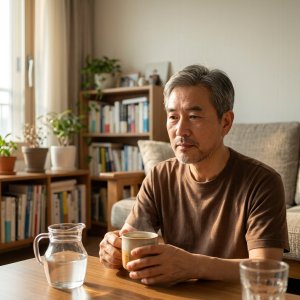
기온이 떨어지면서 부모님 댁 실내 온도와 외출 후 컨디션을 확인하는 보호자가 늘고 있다. 고령층은 추위를 감지하는 피부 감각이 둔해지고 체온을 만드는 근육량이 줄어들어 본인도 모르게 저체온이나 혈관 수축이 진행될 수 있어 정기적인 확인이 필요하다.
떨림·어눌한 말투, 저체온 초기 신호
노년기에는 체온 조절 중추와 말초 혈관 반응이 약해져 같은 추위에서도 체온이 더 빨리 떨어진다. 질병관리청은 고령자의 체온과 실내 온도를 자주 확인하라고 권고한다.
[저체온 위험 신호 점검]
- 평소보다 심하게 떨거나 말이 어눌해졌다
- 지나치게 졸리거나 반응이 둔하다
- 손발과 얼굴이 차갑고 창백하다
- 젖은 옷이나 땀에 젖은 속옷을 오래 입고 있다
→ 2개 이상 해당하면 즉시 따뜻한 곳으로 이동시키고 젖은 옷을 벗긴 뒤 마른 옷과 담요로 감싼다. 의식 저하나 심한 졸림이 있으면 119에 연락한다.
실내 18도 유지와 환기 균형
실내가 충분히 따뜻하지 않으면 체온 유지 부담이 커지고 혈관이 수축된 상태가 지속된다. 난방기 주변 안전과 환기도 함께 챙겨야 한다.
[실내 환경 점검 항목]
- 실내 온도가 18도에서 20도로 유지된다
- 잘 보이는 곳에 온도계가 있다
- 난방기 주변에 이불이나 의류 등 불이 붙기 쉬운 물건이 없다
- 하루 2회에서 3회, 10분에서 30분씩 환기한다
→ 실내가 충분히 따뜻해지지 않으면 난방이 가능한 다른 거주 공간으로 옮기는 것도 고려한다.
외출 전 체감온도 확인과 겹쳐 입기
찬바람이 피부에 직접 닿으면 체온이 빠르게 빠져나가고 혈관이 급격히 수축된다. 고령층은 체온 유지 능력이 약하므로 머리, 목, 손발을 따뜻하게 보호해야 한다.
[외출 준비 확인 사항]
- 외출 전 기온과 체감온도를 확인했다
- 내복 또는 얇은 옷을 여러 겹 입었다
- 모자, 목도리, 마스크, 장갑을 착용했다
- 미끄럼 방지 신발과 따뜻한 양말을 신었다
→ 한파 때는 새벽 운동이나 장시간 야외활동을 피하고, 땀이나 눈비로 옷이 젖으면 즉시 갈아입는다.
혈압약 복용 시간과 급격한 온도 변화
추운 날 실내에서 갑자기 밖으로 나가면 혈관이 순간적으로 수축하며 혈압이 치솟는다. 고혈압이나 심뇌혈관질환이 있는 경우 무리한 활동과 급격한 온도 변화를 피해야 한다.
[혈압과 심뇌혈관 안전 점검]
- 혈압약 등 처방약을 정해진 시간에 복용한다
- 추운 날 혈압을 평소보다 자주 확인한다
- 실내에서 나갈 때 갑자기 찬 공기에 노출되지 않는다
- 가슴 통증이나 압박감, 호흡곤란, 식은땀이 없다
→ 가슴 통증, 호흡곤란, 의식 변화 또는 한쪽 팔다리 힘 빠짐, 말 어눌함 같은 뇌졸중 의심 증상이 나타나면 즉시 119에 신고한다.
평소 사소하게 여겼던 실내 온도, 외출 후 어지럼증, 떨림 정도를 정기적으로 확인하는 습관이 찬바람 속에서도 건강한 노후를 지키는 든든한 방패가 된다. 혼자 사는 부모님이라면 보호자가 주 2회에서 3회 전화나 방문으로 체온과 혈압을 함께 점검하고, 증상이 반복되면 기록 후 의료진 상담을 고려한다.
댓글 0
아직 댓글이 없습니다. 첫 댓글을 남겨보세요!