홈 HOT 문화 푸드 여행 스포츠 라이프 건강 실버 뷰티 패션 경제 게임 IT 부동산

서비스 정보

사이트 소개 문의하기 이용약관 개인정보처리방침 청소년보호정책

물 마실 때 콜록콜록, 그냥 넘기지 마세요…삼킴 장애 확인 필요

핵심 요약

  • 식사 중 잦은 사레는 흡인성 폐렴의 초기 신호일 수 있습니다.
  • 상체를 세우고 천천히 먹으며 구강 위생을 철저히 관리하세요.
  • 턱 당기기나 음식 점도 조절은 전문가 평가 후 적용해야 합니다.
  • 사레 횟수, 증상 기록은 진료에 중요하며, 이상 시 즉시 진료받으세요.

이런 분들이 읽으시면 좋습니다

  • 식사 중 사레가 자주 들리거나 음식이 목에 자주 걸리는 70대 이상 어르신
  • 부모님이 식사 후 기침을 반복하거나 목소리가 변하는 것을 관찰한 보호자
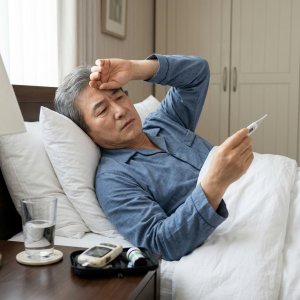
  • 반복되는 미열과 가래가 지속돼 폐렴 예방 수칙을 확인하려는 가족

Create a high-quality blog thumbnail image for the article titled: "환절기 체온 유지 음료: '따뜻한 한방차(생강·쌍화차)' vs '미지근한 생수 자주 마시기'".
Style: healthy and active lifestyle photography
Requirements:
- Realistic photography, photorealistic, documentary style
- Natural lighting, high detail, sharp focus
- Modern and clean design
- No text in the image (if text is needed, use large bold sans-serif fonts)
- Suitable for blog header/thumbnail
- High resolution, professional quality
- Visually appealing and relevant to the topic
- If any Korean text appears, it must be properly composed and OCR-readable
- NO broken, distorted, or illegible characters
- NO cartoon, NO illustration, NO anime, NO artwork, NO drawing, NO painting, NO sketch

Additional requirements:
[STYLE] Realistic documentary / photojournalism. Natural daylight or soft indoor light, candid and authentic. Real Korean subjects, natural skin texture, shallow depth of field with natural bokeh. No beauty filter, no studio strobes, no cinematic grading. Default to present-day contemporary Korea (year 2026) — modern interiors, current clothing, up-to-date devices and furnishings; no film-grain or dated color cast. Keep the look clean and comfortable to view — natural but not gritty or off-putting. Show conditions the article is actually about (a rash, a wound, sweat after exercise, a skin problem) when they are the topic, but render them mild, restrained, and non-graphic — enough to communicate, never raw, glistening, gory, or repulsive. When such detail is not the topic, keep skin healthy and clothing, bags, and shoes clean and tidy rather than stained or filthy. Exception: if the article is explicitly about the past or a specific earlier era, match that period's authentic look instead.

[PRIORITY] When instructions conflict, follow this order: (1) article accuracy and logical plausibility; (2) subject age, identity, and medical/location accuracy; (3) natural documentary realism; (4) text avoidance and physical correctness; (5) visual differentiation across the set; (6) styling and color variety. Never sacrifice factual or narrative accuracy merely to make images look more varied.

[SAFE DEFAULT] When the article does not clearly specify a place, object, or complex action, prefer a simple, ordinary, clean composition over an elaborate one: a plain everyday setting, a calm single subject or simple still life, uncluttered background, few objects. When any detail is uncertain or hard to render reliably (a specific real place, a busy scene, a complex hand action, on-screen or printed text), simplify or leave it out rather than inventing or forcing it. A clean, generic, believable image is always better than an ambitious but flawed one.

[SET] This is one coherent image set for a single article (body images + one thumbnail), all in the same realistic style and topic but each visibly different. The thumbnail follows the same photo rules — never illustration. Treat each article as a new casting: its people should look fresh and distinct, not resembling a default face or the people used in other articles. Visual variety must never override identity, location, or logical continuity when the same person, place, or same-day event continues across images.

[CASTING] Derive the person from the article body, not from a default. Read who the article is actually about — the person in its cases, examples, symptoms, or scenarios — and cast that person's gender, age, and situation. If the body specifies or implies a particular person (a man in his 60s, a mother of a toddler, an office worker), depict that person. If it does not specify, choose deliberately and cast men as often as women — do not default to female subjects across unrelated articles. Subject age must strictly match the topic, including in the thumbnail and background figures: pediatric → children and caregivers; adolescent topics → teens; young-adult topics → 20s; working-age topics → 30s–50s; senior/elderly topics → older adults (60s–80s), with no young adults or children as the focus. Cover the full age range across health subjects — teens and people in their 20s belong in topics that concern them (growth, posture, vision, skin, mental health, diet, fitness), not only older adults. Match each article to its real target age, and never make an elderly subject look artificially youthful or a senior topic look young. Within that age range, pick a distinct look, such as: a lean long narrow face with sharp cheekbones; a stocky build with a broad jaw and thick brows; a round soft face with full cheeks and a gentle stoop; a tall angular frame with a high forehead and swept-back hair; a small slight build with fine features and thick glasses; a heavyset frame with a wide face and short cropped hair; a fair complexion with a low tied-back bun; a thinning or balding hairline with black-rimmed glasses; a square face with a strong jaw and deep-set eyes; a compact muscular build with a thick neck and close-cropped hair. Vary hair (cropped, parted, tied back, permed, thinning, black, dyed, salt-and-pepper, gray, white), skin tone, build, posture, and glasses — all matched to the required age. When the same person appears across multiple images in one article, preserve the same facial structure, approximate age, hairstyle, hairline, glasses, and body build — do not recast or subtly redesign them between scenes. When the topic allows, back views, over-shoulder shots, hands-only framing, or scenes without people are valid too.

[SUBJECT] People and real situations are usually the main subject — never a product or object turned into an advertising hero. When the article is about a place, food, object, or phenomenon rather than a person, a people-free scene (a landscape, a room, an ingredient, an everyday object in use) is fully valid; choose whichever the article actually calls for. Subjects are predominantly Korean (East Asian). The scene must read at a glance (problem, consultation, treatment, or daily life). Candid gaze, absorbed in the situation, not posing or staring at the camera. Match emotion to the article stage — mild concern for a problem, focused attention during consultation, calm relief for recovery or daily life — not a worried face by default, and never theatrical despair or an advertising smile. Use the minimum number of people needed to communicate the scene; do not add background crowds unless the setting genuinely requires them.

[THUMBNAIL] Same realistic-photo rules — never illustration. Tighter crop on one person's face/expression or a single clear situation, readable in under one second. When practical, leave a naturally uncluttered area in the upper third or one side of the frame — real photographed background (sky, wall, plain surface, or soft bokeh), part of the scene, not a graphic panel. Never draw a box, banner, bar, overlay, placeholder, or any flat shape for a title; the image is a pure photograph edge to edge. Keep the thumbnail free of prominent or readable text — no sharp clothing prints, signs, or background lettering as a focal point; frame them out or keep them softly out of focus. The thumbnail subject's age must match the topic.

[WARDROBE] The current season is summer (update this word when the season changes); dress everyone for that season's real weather (summer = light short sleeves and breathable fabrics, no jackets; winter = thick knit or padding; spring/autumn = light layers). If the article body implies a specific season, setting, or activity (a winter topic, exercise, sleep, bathing, hospital, outdoor work), let that decide the clothing instead. Ordinary age-appropriate Korean wear or real uniforms; no prints, logos, or brand tags. Keeping one person's outfit consistent across a same-day sequence is natural and correct. What to avoid is the set as a whole looking monotonous: give each image a genuinely different wardrobe — do not put everyone in the same or a similar color (e.g. not "everyone in light blue"), and do not repeat the same tone, top-and-bottom combination, or clothing style from image to image. Actively spread across distinct color families image by image (e.g. one navy, one warm beige, one olive, one rust, one charcoal, one muted green). Exception: genuine uniforms (medical scrubs, nurse or caregiver wear, workwear) may share the same color and style — do not force artificial variation on them.

[LOCATION] Choose the setting from the article's actual context and vary it across topics — home, clinic, pharmacy, street, park, market, workplace, or transit — rather than defaulting to a living room or hospital every time. Use believable present-day Korean environments with props and furniture that fit; avoid generic AI studio rooms or showroom-perfect interiors. For a specifically named real place (travel destination, landmark), faithfully match its real architecture, terrain, and layout; do not invent or stylize a fictional version. If accurate reproduction is uncertain, use a plain non-identifiable setting instead of a wrong depiction.

[SCENE] Landscapes, interiors, food, and objects may appear on their own when the article is about them. Depict only real, plausible things true to how they actually look — real Korean places, real dishes, real everyday objects with correct proportions and materials. Never invent a fictional or fantastical version: no imaginary landmarks, no made-up food, no impossible or surreal objects, no fictional signage. If a specific real place or dish is named, match its genuine appearance; if it cannot be shown accurately, use a plain generic version rather than a wrong or invented one. Keep any incidental text (menus, signs, packaging) off-frame, turned away, or far out of focus — the object itself carries the image, not lettering. Compose objects and food as natural editorial photography, not as centered product-catalog or advertisement shots.

[PEOPLE] For groups or family scenes, naturally mix ages, genders, and body types. Medical scenes use plausible settings, equipment, and gestures. Any medical imaging (X-ray, scan, chart) must anatomically match the article's body part — a hand article shows a hand X-ray, never a spine or unrelated part. If unsure, keep imaging out of frame or fully out of focus.

[TEXT CONTROL] Text is not forbidden, but it must never be prominent or readable. Do not fake or distort lettering. When text would naturally exist (a sign, a screen, packaging, a document), keep it small, incidental, and unreadable through composition — off-frame, turned away, blocked by a hand or object, or far in soft background bokeh — never sharp, centered, or eye-catching. If a product appears, keep it small and out of focus or show the action (e.g., taking a pill) — never a product as a hero object. No prominent brand names, logos, or promotional look — editorial only. Keep name badges, employee IDs, embroidered clinic names, clock faces, room numbers, license plates, receipts, medicine instructions, printed forms, and newspaper or magazine titles unreadable — fold, angle away, or push far out of focus. Electronic devices (phone, laptop, tablet, TV) must be physically correct: a display only on the actual screen side; the back and edges are solid opaque casing with no screen or glow. Never put a display on the rear or a non-screen surface. Prefer devices seen from the user's side, screen off/dark, or angled away.

[ANATOMY] Keep all visible anatomy natural and physically plausible, with correct limbs, joints, hands, and facial structure. Prefer simple, relaxed poses; if a hand pose gets complex, simplify it (in pocket, on lap, loosely holding). Faces are intact and natural (back/side views allowed), never faceless or distorted. Keep background people physically plausible too.

[DIFFERENTIATION] Within the set, each image — including the thumbnail — must be clearly distinct in wardrobe color, action, pose, camera angle, and background; treat visible repetition (same clothing color, same gesture, same framing across images) as a failure. Deliberately use a range of shot types: at least one wide environmental shot showing the full setting, one medium shot, and one close detail (hands, objects, or expression) — do not make every image a waist-up medium portrait. At least one image should not center a face (hands, a back view, an over-shoulder angle, or an environmental scene). Vary camera angle, gaze direction, action, body position, and story stage (problem / consultation / treatment / daily life); mix front, side, back, and three-quarter views. Change location only when the narrative logically calls for it — do not force an unrelated setting merely for variety, and never break identity or same-day continuity for the sake of variety.

[NEGATIVE] illustration, clipart, cartoon, vector art, flat design, infographic, 3D render, anime, drawing, painting, garbled text, fake lettering, prominent readable text, sharp centered lettering, readable sign or label, readable brand name, readable newspaper or magazine title, identifiable publication, readable name badge or ID, clock with clear numbers, license plate, captions, watermarks, advertisement look, promotional poster, white box, blank rectangle, banner, title placeholder, overlay panel, solid color block, graphic bar, flat shape over photo, text on thumbnail, mismatched or wrong-body-part x-ray, anatomically inconsistent medical image, incorrect medical equipment, implausible medical pose, screen on the back of a device, display on non-screen surface, double-sided screen, fictional or inaccurate real place, fake landmark, wrong architecture for a named place, fictional landscape, imaginary place, surreal scenery, made-up food, impossible object, distorted proportions, product-centric close-up, fake packaging, oversized product placement, product-catalog framing, generic posed stock-photo aesthetic, empty white studio background, deformed hands, extra or missing fingers, three or six fingers, fused fingers, extra or missing limbs, extra arms, mutated body, bad anatomy, disfigured, faceless, distorted face, asymmetrical or crossed eyes, beauty filter, plastic skin, waxy over-detailed skin, overly hyperreal, raw gory detail, glistening sweat, bloody wound, graphic injury, oozing sore, repulsive close-up, filthy stained clothing, grimy shoes, off-putting grungy look, studio strobe, exaggerated smile, exaggerated despair, posed stock-photo expression, staring at camera, unnecessary background crowd, wrong-era anachronism, dated color cast, film grain, faded vintage tone, out-of-season clothing, winter clothes in summer, same clothing color across images, everyone in the same color, matching outfits across the set, monotonous repeated clothing colors, cloned faces, same recurring face across articles, recast person between scenes, default stock face, non-Korean dominant cast, age mismatch with topic, youthful face for elderly subject, near-duplicate composition, repeated pose or angle, repeated gesture, monotonous framing, similar composition across images

## [PERSON APPEARANCE VARIATION — apply ONLY if this image includes people]
If people appear in this image, the main person must be a Korean man in his 60s with these exact features: soft V-line face with defined chin, close-set eyes, angular eyebrows, straight refined nose bridge, rounded forehead, ears covered by hair, short neat side-part hair, warm-toned skin, light freckles, a calm neutral expression, average build, neatly trimmed short beard.
Wearing: brown crew-neck tee (adjust to season/context of the article).
Composition: eye-level medium shot.
These appearance details OVERRIDE any other demographic guidance in this prompt.
If this image does not naturally include people, ignore this section entirely.

평소 식사는 잘하시던 분이 갑자기 사레가 잦아지거나, 삼킨 뒤에도 목에서 가래 끓는 소리가 계속 들린다면 흡인 신호일 수 있다. 침이나 음식물이 기도로 넘어가 폐에 염증을 일으키는 흡인성 폐렴은 고령자에게서 자주 발생하며, 조기 예방과 식사 자세 조정이 중요하다.

목에 음식 걸리는 횟수 늘더니, 검사에서 폐렴 진단

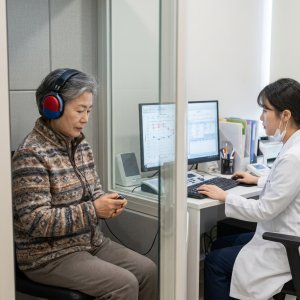
김모씨(72세)는 지난 석 달 동안 식사 중 사레가 부쩍 잦아졌다. 국물을 마실 때마다 목에서 걸리는 느낌이 들었고, 물을 마신 뒤 기침이 계속됐다. 처음에는 "나이 들면 다 그렇지"라고 생각했지만, 식사 후 목소리가 쉬고 가래가 끓는 소리가 반복되자 딸 이모씨(48세)가 이상함을 느꼈다. 병원에서 검사를 받은 결과 흡인성 폐렴 초기 단계로 확인됐고, 의료진은 삼킴 반사가 약해지면서 음식물과 침이 기도로 넘어간 것으로 판단했다.

흡인성 폐렴은 음식물, 물, 침, 위 내용물이 식도가 아닌 기도를 거쳐 폐로 들어가 염증을 일으키는 질환이다. 정상적으로는 삼킬 때 후두가 닫히고 기침 반사로 이물질을 배출하지만, 노화나 뇌졸중, 치매, 진정제 사용 등으로 이 기능이 약해질 수 있다. 고령자는 흡인이 일어나도 기침을 제대로 못 하는 경우가 많아, 반복되는 미열, 가래, 식후 숨참, 목소리 변화, 식욕 저하가 초기 신호로 나타날 수 있다.

[사례에서 먼저 보이는 변화]

  • 물이나 국물을 마실 때 목에 걸리는 느낌과 기침 반복
  • 식사 후 목소리가 쉬거나 젖은 소리가 지속됨
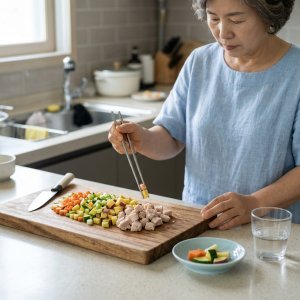
  • 평소보다 식사 시간이 길어지고 음식을 삼키기 전 망설이는 모습

사레 반복되면 식사 자세부터 점검, 턱 당기기는 전문가 확인 후

광고

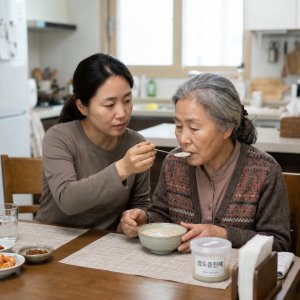
김모씨는 퇴원 후 식사 전 상태 확인과 자세 조정을 먼저 시작했다. 의료진은 식사 전 완전히 깨어 있는지 확인하고, 의자에 앉아 상체를 90도에 가깝게 세운 뒤 한 번에 한 숟가락씩 천천히 먹도록 안내했다. 앞의 음식을 완전히 삼킨 뒤 다음 음식을 넣고, 식사 중 말하거나 웃지 않도록 주의했다. 식사 후에도 바로 눕지 않고 최소 30분은 앉은 자세를 유지하는 것이 권장됐다.

턱 당기기 자세는 삼킬 때 인두와 후두 주변을 지지하고 기도 쪽으로 음식물이 들어가는 것을 줄이기 위한 보상 자세다. 등을 곧게 펴고 안정적으로 앉은 뒤, 삼키는 순간 턱을 가슴 쪽으로 부드럽게 당기는 방식이다. 다만 모든 사람에게 효과적인 것은 아니며, 일부 환자에서는 오히려 삼킴이 불편해질 수 있어 반복적인 사레나 삼킴장애가 있으면 전문가의 평가 후 적용해야 한다. 턱을 지나치게 가슴에 붙이거나 고개 전체를 심하게 숙이지 않도록 주의하고, 목소리가 젖거나 기침이 계속되면 식사를 중단한다.

[식사 전후 점검 기준]

  • 식사 전 의식이 또렷한지, 졸리거나 흐리면 억지로 먹이지 않기
  • 상체를 90도 세우고 한 번에 작은 숟가락 또는 한 모금씩 천천히
  • 식사 후 최소 30분은 앉은 자세 유지, 바로 눕지 않기

구강 위생 관리와 반복 신호 기록, 상담 자료로 활용

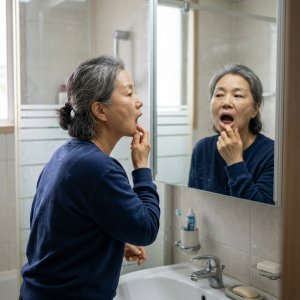
김모씨는 식사 자세 조정과 함께 구강 위생 관리를 강화했다. 치아뿐 아니라 혀와 입천장도 부드럽게 닦고, 하루 2회 이상 구강을 청결히 유지했다. 의치가 있다면 청결하게 관리하고 식사 전 잘 맞는지 확인하는 것도 중요하다. 구강 내 세균이 침이나 음식물과 함께 폐로 들어가면 감염 위험이 커지기 때문이다.

딸 이모씨는 식사 중 기침이나 호흡곤란이 나타나는 횟수를 날짜와 시간대별로 기록했다. 어떤 음식에서 사레가 자주 들렸는지, 식사 후 목소리 변화가 지속됐는지를 적어두고 다음 외래 방문 때 의료진에게 전달했다. 물처럼 묽은 액체에서 자주 사레가 들리면 음식의 크기, 부드러움, 점도를 조정해야 하며, 임의로 걸쭉하게 만들기보다는 의료진이나 언어재활사의 평가를 받는 것이 안전하다.

[상담 전 기록 항목]

  • 사레가 자주 드는 음식 종류와 발생 시간대 기록
  • 식사 후 목소리 변화, 가래 끓는 소리, 기침 지속 여부 확인
  • 반복되는 미열, 식욕 저하, 기력 저하가 함께 나타나는지 관찰

[상황별 선택 기준]

  • 식사 중 기침이 반복되고 목소리가 젖는다면 → 턱 당기기 자세를 임의로 적용하지 말고 언어재활사 평가 먼저
  • 물이나 국물에서만 사레가 들린다면 → 음식 점도 조정 전 의료진 상담, 임의 조정 금지
  • 반복되는 미열과 가래가 2주 이상 지속된다면 → 흡인성 폐렴 가능성 확인 위해 즉시 진료

식사 중 사레는 단순 노화 현상으로 넘기기 쉽지만, 반복되고 동반 증상이 있다면 흡인 신호일 수 있다. 상체를 세우고 천천히 먹는 자세 조정과 구강 위생 관리를 먼저 시작하고, 턱 당기기 같은 보상 자세는 전문가 평가 후 적용한다. 사레 발생 횟수와 음식 종류를 기록해두면 상담 때 정확한 판단 자료가 된다.

Trending Now
@keyframes hw-spin { to { transform: rotate(360deg); } }