홈 HOT 문화 푸드 여행 스포츠 라이프 건강 실버 뷰티 패션 경제 게임 IT 부동산

서비스 정보

사이트 소개 문의하기 이용약관 개인정보처리방침 청소년보호정책

단단하게 부푼 배, 내장지방 경고일까…허리둘레부터 먼저 확인

핵심 요약

  • 단단하게 부푼 배와 적은 피하지방은 내장지방 신호입니다.
  • 내장지방은 당뇨병, 고혈압, 심혈관질환 위험을 높입니다.
  • 허리둘레, 생활 습관, 혈압·혈당·지질 수치로 확인하세요.
  • 야식 줄이기, 식후 산책 등 생활 습관 개선이 중요합니다.

Create a high-quality image for a blog article.
Description: 병원 상담실에서 의료진과 복부 둘레 측정 결과를 확인하는 65세 한국인 여성, 가벼운 카디건 착용
Style: modern and clean photography
Requirements:
- Photorealistic or high-quality illustration
- No text overlays (if text is needed, use large bold sans-serif fonts)
- Professional quality suitable for blog content
- Visually appealing and relevant to the description
- If any Korean text appears, it must be properly composed and OCR-readable
- NO broken, distorted, or illegible characters

Additional requirements:
[STYLE] Realistic documentary / photojournalism. Natural daylight or soft indoor light, candid, authentic. Real Korean subjects, natural skin texture, shallow depth of field with natural bokeh. No beauty filter, studio strobes, or cinematic grading. Present-day Korea (2026): modern interiors, current clothing, up-to-date devices; no film grain or dated color cast. Keep it clean and comfortable to view — natural, not gritty. Show a condition the article is actually about (rash, wound, post-exercise sweat) only when it is the topic, then mild and non-graphic — never raw, gory, or repulsive. Otherwise keep skin healthy and clothing, bags, shoes, dishes, cups, and props clean and tidy — lived-in but not dirty: no coffee drips, food stains, spills, or grime unless the article is about cleaning or a mess. Exception: if the article is explicitly about the past or an earlier era, match that period.

[PRIORITY] On conflict, order: (1) article accuracy and logic; (2) subject age, identity, continuity, medical/location accuracy; (3) documentary realism; (4) text avoidance, object clarity, physical correctness; (5) differentiation across the set; (6) styling and color variety. Never sacrifice accuracy, identity continuity, or narrative logic for variety, color, or drama.

[SAFE DEFAULT] Keep scenes simple and clean: a plain setting, a calm subject or still life, uncluttered background, few objects. If any detail is uncertain or hard to render, simplify, crop, obscure, or omit it — never invent or force it; a clean believable image beats an ambitious flawed one. Actively avoid setups AI renders poorly: many identical labeled items facing the camera (store shelves, fridge cases, book spines, parked cars, signage walls); scenes that only work if text is read (receipts, prescriptions, screens, schedules, charts); precise tool-in-hand close-ups (injections, blood draws, stitching, cotton swab in the ear); exact real-world specifics (named landmarks, brand logos, maps, currency); and making any text-bearing object the focal point. When a topic seems to need one of these, convey it indirectly — through a person's gesture and expression, a single item with text hidden, or the moment just before/after the action — keeping such elements minimal and out of focus. Prefer visually unmistakable action over scenes that need text to be understood.

[SET] One coherent image set for a single article (body images + one thumbnail), same style and topic, each visibly different. Thumbnail follows the same photo rules — never illustration. Treat each article as new casting: fresh, distinct people, not a default face or those used in other articles. Variety must never override identity, location, wardrobe, or logical continuity when the same person, place, or same-day event continues.

[CASTING] Derive the person from the article body, not a default: read who it is about (cases, examples, symptoms, scenarios) and cast their gender, age, situation. If the body implies a specific person (man in his 60s, mother of a toddler, office worker), depict that person. If unspecified, choose deliberately and cast men as often as women — never default to female across unrelated articles. Age must match the topic, including thumbnail and relevant background figures: pediatric → children + caregivers; adolescent → teens; young-adult → 20s; working-age → 30s–50s; senior → 60s–80s (no young adults/children as main focus). For general health/lifestyle not senior-targeted, default to 20s–30s (teens or 40s–50s when the topic calls for it); do not default to elderly for non-senior topics; reserve 60s–80s for senior or age-related topics. Never make an elderly subject look youthful or a senior topic look young. Within the required age, pick a distinct look, e.g.: lean, long narrow face, sharp cheekbones / stocky, broad jaw, thick brows / round soft face, full cheeks, slight stoop / tall angular, high forehead, swept-back hair / small slight, fine features, thick glasses / heavyset, wide face, cropped hair / fair complexion, low tied-back bun / thinning or balding, black-rimmed glasses / square face, strong jaw, deep-set eyes / compact muscular, thick neck, close-cropped hair. Vary hair (cropped, parted, tied back, permed, thinning, black, dark brown, dyed, salt-and-pepper, gray, white), skin tone, build, posture, glasses — matched to the age. When the same person recurs in one article, keep the same facial structure, age, hairstyle, hairline, glasses, build — do not recast between scenes. Back views, over-shoulder, hands-only, or people-free framing are valid when the topic allows.

[SUBJECT] People and real situations are usually the main subject — never a product as an advertising hero. When the article is about a place, food, object, ingredient, or phenomenon, a people-free scene is fully valid; choose what the article calls for. Predominantly Korean (East Asian). The scene reads at a glance through the situation itself (problem, consultation, exam, treatment, recovery, comparison, decision, daily life). Candid gaze, natural body language, absorbed in the situation, not posing or staring at the camera. Match emotion to the stage — mild concern for a problem, thoughtful for a choice, focused in consultation, calm relief in recovery/daily life — never a default worried face, theatrical despair, or advertising smile. Use the fewest people needed; no background crowds unless the setting requires them.

[THUMBNAIL] Same realistic-photo rules — never illustration. Tighter crop on one face/expression, one clear action, or a single unmistakable situation, readable in under a second. Pure photograph edge to edge — no title, caption, lettering, box, banner, overlay, placeholder, or flat shape anywhere, especially across the top; empty space is just ordinary photographed background, never a reserved panel or fabricated blank surface. Get clean framing via angle, crop, depth of field, and subject placement. Thumbnail age and situation must match the topic.

[WARDROBE] Current season is summer (change this word as seasons change); dress for that season's real Korean weather (summer = light short sleeves, breathable fabrics, no heavy jackets; winter = knit, coats, padding; spring/autumn = light layers). If the body implies a specific season, setting, or activity (winter topic, exercise, sleep, bathing, hospital, outdoor work), let that decide instead. Ordinary age-appropriate Korean wear or authentic uniforms; no prints, slogans, logos, or brand tags. In a same-day continuous sequence, continuity wins: keep the person's clothing consistent unless the narrative requires a change. For color, actively lead with warm/earthy families — terracotta, mustard, olive, forest green, burgundy, warm brown, cream, rust, dusty rose, deep teal — varying hue, brightness, saturation, fabric, and silhouette across the set. Cool blue, navy, beige, white, gray may appear occasionally but must not become automatic or dominate; do not dress unrelated people in the same/similar color, and never use medical-looking pale blue just because the topic is health. Keep colors realistic and age-appropriate. Exception: genuine uniforms (scrubs, caregiver wear, lab coats, school uniforms, workwear) may share colors and styles.

[LOCATION] Pick the setting from the article's context and vary it across topics — home, clinic, hospital, pharmacy, street, park, market, workplace, school, restaurant, community center, transit — not always a living room or hospital. Believable present-day Korean environments with fitting architecture, furniture, and props; no generic AI studio rooms or showroom-perfect interiors; lived-in but clean enough for editorial. For a named real place, match its real architecture, terrain, and layout; never invent, stylize, or substitute a fictional version. If uncertain, use a plain non-identifiable setting rather than a confidently wrong one.

[SCENE & REALNESS] Landscapes, interiors, food, ingredients, and objects may stand alone when the article is about them. Depict only real, plausible things as they normally look, with correct proportions, materials, and relationships. No fictional or fantastical substitutes: no imaginary landmarks, made-up food, impossible devices, surreal objects, or fictional signage. If a specific real item is named, match its genuine look; if it can't be shown accurately, use a plain generic version, not a wrong or invented one.

[OBJECT & COMPOSITION] Compose like real editorial photography, not staged demos, ads, or AI catalog shots. Avoid perfect symmetry, default-centered subjects, and objects lined up toward the lens; allow natural overlap, partial cropping, depth, slight asymmetry, ordinary placement. Keep one primary subject/action, few supporting elements, a believable background. Packaged items (milk/soy-milk cartons, medicine boxes, cosmetics, supplements, household goods) must look like real ordinary Korean products with normal packaging design — realistic shape, cap, colors, simple graphic blocks — never blank white packaging and never covered in generated lettering; fine print reads as soft unfocused texture, not spelled-out words. Hide the brand-name area (a hand on the label, a slight side angle, an edge crop) while the product stays identifiable by shape, color, and design — recognizable as "a milk carton / a medicine box" with no readable brand name. Keep products minimal — one or two items, not a filled shelf or fridge. Distinguish similar items by color, design, and context (contents, vessel, the person's action), not labels; serving food or drink in bowls, cups, or plates is also fine.

[PEOPLE] Groups/family scenes mix ages, genders, faces, body types when appropriate; don't add people to fill the frame. Medical scenes use plausible settings, equipment, uniforms, positioning, gestures. Medical imaging (x-ray, scan, ultrasound, chart) must match the body part discussed — hand article → hand/wrist, never an unrelated part; if uncertain or non-essential, keep it out of frame or out of focus. No unnecessary IV bags, injections, surgical gear, monitors, or dramatic props for medical effect.

[TEXT CONTROL] Avoid generating visible text; it should never be needed to understand the image. Do not fake, scramble, or distort lettering — that produces garbled pseudo-text; remove text through composition (out of frame, turned away, cropped, blocked, or in soft background bokeh). Treat every text-bearing object as "text side hidden by default": medicine bottles/boxes → plain back, hand over the label, or the pills/action instead of the labeled front; signs/storefronts → behind the subject, cropped, or deep out of focus, never facing the camera in focus; books/magazines → cover angled away, spine-in, or held hidden, never a readable title; monitors/phones/TVs → screen off, dark, angled away, or a soft glow only, never sharp on-screen content. Any letter-bearing surface must be turned, blocked, cropped, or blurred enough that no lettering forms; if a shot can't avoid a sharp text surface, change the angle until it can. No readable brand names, logos, publication titles, name badges, room numbers, plates, or forms; unavoidable incidental text stays tiny, distant, out of focus. Packaging is the deliberate exception (see OBJECT & COMPOSITION): realistic printed look, brand name hidden — never a blank package or sharp fake words. Devices are physically correct: a display only on the real screen side; rear, edges, and casing have no screen or glow; never a display on a non-screen surface.

[ANATOMY & OBJECT REALISM] Natural, physically plausible anatomy — correct limbs, joints, hands, fingers, facial structure, proportions. Simple relaxed poses; if a hand pose gets complex, simplify it (on a lap or table, loosely holding one object, partly out of frame, or obscured); no unnecessary multi-object hand interactions. Faces intact and natural (back, side, partial views allowed), never faceless, melted, or distorted; background people plausible too. Objects obey real-world scale, count, and structure: normal proportions (a cotton swab is short), correct number (one swab in one hand — not two, not one in each hand), complete structure (a refrigerator has doors, a mug one handle, a chair four legs); no extra/missing/fused parts, impossible sizes, or duplicated tools. For a small precise action (swab to the ear, tweezers, thermometer), keep one correctly sized tool, in one hand, in a simple pose, at a slightly pulled-back angle. Scenes must be internally consistent: an object in active use is not also resting in its place — a person eating with a spoon in hand has only chopsticks left on the table, not a full set; no duplicated or leftover copy of what someone holds; settings match the moment (a half-eaten meal looks eaten).

[DIFFERENTIATION] Each image (including thumbnail) must be visibly distinct without breaking continuity. Pose and facial expression must never repeat across the set — every image a different body pose and expression, even for the same person; treat a shared pose or expression as a failure. Also differentiate via two or three of: shot distance, angle, action, gaze, subject placement, background, depth of field, or story stage. For independent or different-day images, vary wardrobe color (avoid the same dominant hue in consecutive independent images) and vary props/tableware (don't reuse the same bowl, plate, cup, or mug design image after image) — but keep both consistent within a same-day continuous scene and for genuine uniforms. Use a range of shots: a wide environmental shot when setting matters, a medium action shot, a close detail — not every image a waist-up medium portrait; at least one may avoid centering a face (hands, back view, over-shoulder, object-in-use, environment). Mix front, side, back, three-quarter, over-shoulder views. Never change identity, clothing, or environment of a continuous same-day scene just for variety.

[NEGATIVE] illustration, clipart, cartoon, vector, flat design, infographic, 3D render, anime, drawing, painting, garbled or fake text, any in-focus or readable lettering, title/header text, text across thumbnail top, readable sign, storefront in focus, readable brand name, spelled-out product name, garbled lettering on packaging, readable medicine label, pill bottle label facing camera, readable book title, sharp monitor or screen content, logos, publication titles, name badges, captions, watermarks, blank white or unlabeled packaging, store shelf or fridge full of products, rows of packaged products, packages lined up toward camera, advertisement look, promotional poster, product hero shot, product-catalog framing, graphic title box, blank title panel, banner, overlay panel, flat shape over photo, mismatched or wrong-body-part x-ray, anatomically inconsistent medical image, incorrect medical equipment, implausible medical pose, unnecessary dramatic medical props, screen on device back, display on non-screen surface, double-sided screen, fictional or inaccurate real place, fake landmark, wrong architecture, made-up food, impossible or surreal object, distorted proportions, oversized or wrongly scaled object, elongated cotton swab, duplicate tool, two tools for a one-tool action, missing refrigerator door, missing/extra/fused object parts, structurally impossible object, duplicated utensil already in hand, spoon on table while holding a spoon, object both held and resting, inconsistent scene logic, same bowl or tableware reused across images, repeated cup or mug design, coffee drips, stained dishes, food stains, spills, grimy or dirty tableware, posed stock-photo aesthetic, empty white studio, perfect symmetry, objects lined up toward camera, malformed anatomy, extra or missing limbs, malformed hands, extra fingers, three or six fingers, fused fingers, distorted or faceless face, severe facial asymmetry, crossed eyes, cloned or duplicated people, beauty filter, plastic or waxy skin, overly hyperreal, raw gory detail, bloody wound, graphic injury, oozing sore, filthy stained clothing, grimy shoes, studio strobe, advertising smile, theatrical despair, posed expression, staring at camera, unnecessary crowd, wrong-era anachronism, dated color cast, film grain, vintage tone, out-of-season clothing, winter clothes in summer, elderly as default for non-senior topics, repeated dominant wardrobe color across unrelated images, everyone in the same or similar color, medical pale-blue as default civilian wear, recurring default face across articles, recast person between continuous scenes, non-Korean dominant cast when Korean required, age mismatch, youthful elderly, same pose or expression across images, near-duplicate composition, repeated angle, monotonous framing

## [PERSON APPEARANCE VARIATION — apply ONLY if this image includes people]
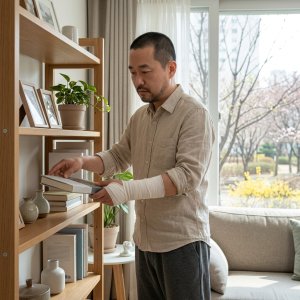
If people appear in this image, the main person must be a Korean man in his 60s with these exact features: soft V-line face with defined chin, small narrow eyes, short sparse eyebrows, slightly wide nose, prominent brow bone, ears covered by hair, neatly combed thinning gray hair, fair skin, no glasses, a focused concentrating expression, petite build, neatly trimmed short beard.
Wearing: light gray summer knit (adjust to season/context of the article).
Composition: candid shot from a diagonal angle.
These appearance details OVERRIDE any other demographic guidance in this prompt.
If this image does not naturally include people, ignore this section entirely.

배가 단단하게 불러 나왔는데 손으로 잡히는 살은 적다면 내장지방을 의심해야 한다. 장기 사이 깊숙이 쌓인 내장지방은 외형 문제가 아니라 당뇨병, 고혈압, 심혈관질환 위험을 높이는 신호다.

허리둘레와 배 상태로 먼저 보는 내장지방 가능성

배가 단단하게 부풀어 오른 상태는 장기 사이 공간에 지방이 꽉 차 있을 가능성을 시사한다. 피하지방처럼 손으로 잡히지 않고 딱딱한 느낌이 든다면 내장지방 축적 신호로 볼 수 있다.

[배 상태 1차 점검]

  • 배가 단단하게 나왔고 손으로 잡히는 살이 적다
  • 허리둘레가 남성 90센티미터 이상 또는 여성 85센티미터 이상이다
  • 허리둘레를 키로 나눈 값이 0.5를 넘는다
  • 체중이 정상이지만 배만 유독 나왔다

→ 2개 이상 해당하면 복부 상태를 기록하고 혈압·혈당·지질검사 확인

야식·당류 습관과 식후 눕는 행동 점검

야식 빈도가 잦고 단 음료나 과자를 자주 먹으면 당류 중독 상태일 수 있다. 식후 바로 눕는 습관은 소화 과정에서 지방 축적을 촉진한다.

[생활 습관 확인]

광고
  • 저녁 식사 후 야식이나 단 음료를 주 3회 이상 먹는다
  • 식후 30분 이내에 눕거나 소파에 앉아 있는다
  • 하루 중 당이 든 음료나 과자를 2회 이상 먹는다
  • 식사 때 탄수화물을 먼저 먹고 채소는 나중에 먹는다

→ 미실행 항목이 있으면 식단 순서 조정과 식후 가벼운 산책을 먼저 시도

혈압·혈당·지질 수치로 대사 위험 확인

내장지방은 혈압·혈당·중성지방 상승과 밀접하게 관련된다. 복부비만 기준을 넘으면서 이들 수치 중 하나라도 높으면 대사증후군 위험이 커진다.

[대사 지표 점검]

  • 최근 1년 내 혈압·공복혈당·중성지방 검사를 받았다
  • 수축기 혈압이 130 이상 또는 이완기 혈압이 85 이상이다
  • 공복혈당이 100 이상 또는 당화혈색소가 5.7 이상이다
  • 중성지방이 150 이상 또는 HDL 콜레스테롤이 남성 40mg/dL 미만, 여성 50mg/dL 미만이다

→ 해당 항목이 있으면 내과 또는 가정의학과에서 대사증후군 여부 확인

지방간·코골이·관절통 동반 여부 기록

내장지방이 많으면 지방간, 수면무호흡, 무릎 부담 같은 합병 증상이 나타날 수 있다. 이런 신호가 반복되면 기록 후 의료진 상담이 필요하다.

[동반 증상 확인]

  • 간수치가 높다는 말을 들었거나 지방간 소견이 있다
  • 밤에 코를 골거나 자다 깨는 일이 잦다
  • 계단 오를 때 무릎이나 허리에 부담이 느껴진다
  • 최근 6개월 사이 배가 더 불러 나왔다

→ 신호가 반복되면 증상 시점과 빈도를 기록 후 의료진 상담 고려

내장지방은 CT로 가장 정확히 측정하지만, 일상에서는 허리둘레 변화와 혈액검사 결과를 함께 확인하는 것이 현실적이다. 생활 습관을 조금만 바꿔도 변화가 시작될 수 있다.
Trending Now
@keyframes hw-spin { to { transform: rotate(360deg); } }